
Benchmarks
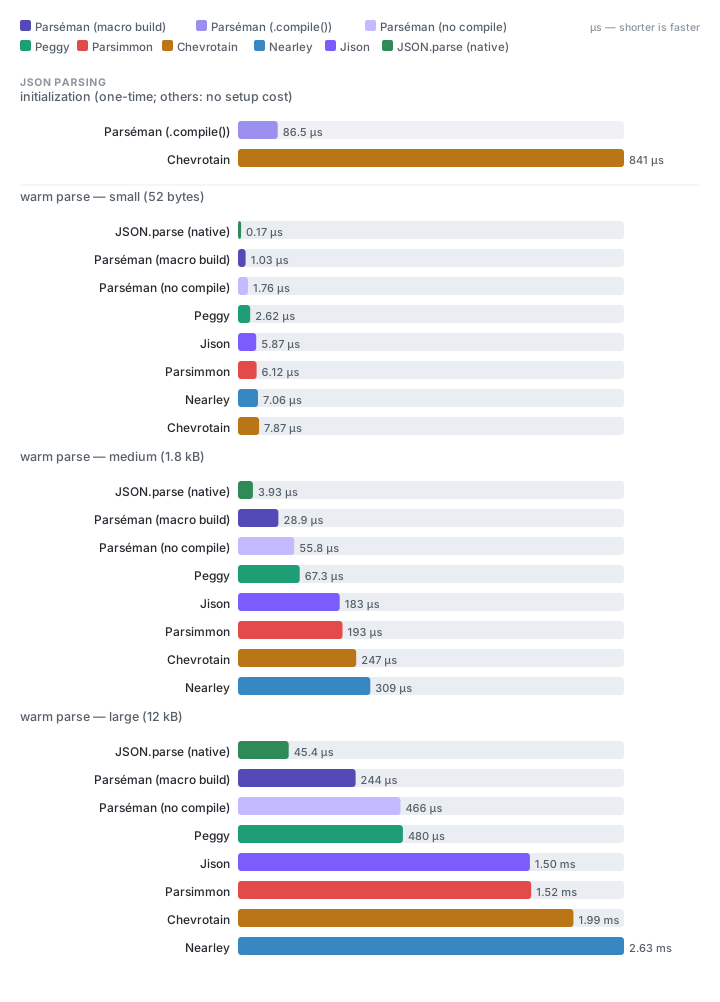
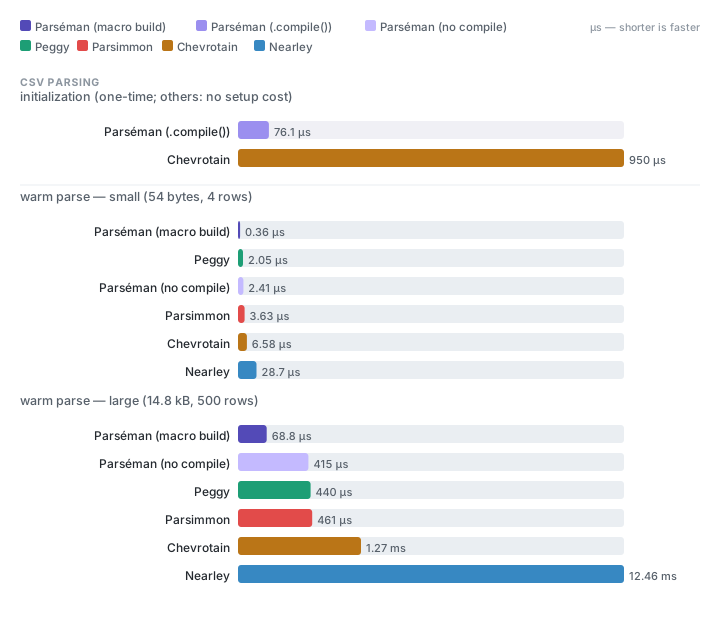
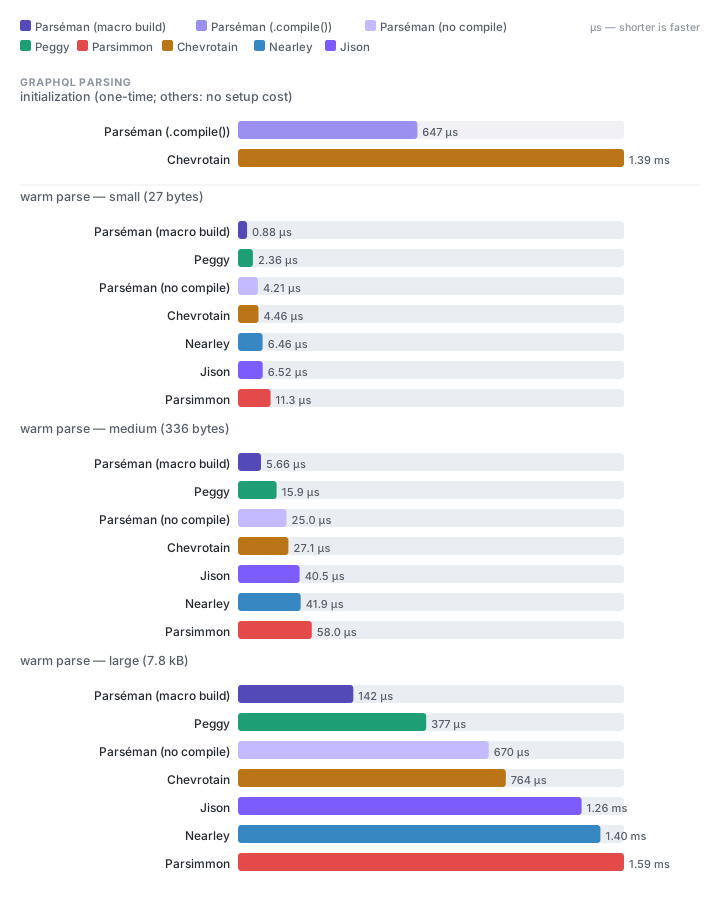
Most parsers spend their life turning text into JS values: JSON into objects, CSV into rows, GraphQL into an AST. So that's what gets measured here, against Peggy, Parsimmon, Chevrotain, Nearley, and Jison, on equivalent small, medium, and large inputs.
Building a syntax tree is a different job with a different field, so it gets its own section — that one adds Lezer. See parsing to a syntax tree.
This page is only about speed. For how these tools actually differ — output shape, context-sensitive grammars, incremental re-parse, error recovery — see How Parséman compares.
Everything below was measured on an Apple M4 Pro running Node 24.11.1. Bars show µs per parse, so shorter is faster.
Where these numbers come from
Every figure on this page is transcribed from assets/bench-*.svg, regenerated for 0.50.2 on 2026-08-29 by pnpm bench:svg. Parséman's compiled bars are the table artifact produced by runtime compile() — the same thing the macro build ships. Each parser runs in its own process, each group over three rotated rounds. If a table and a chart ever disagree, believe the chart.
Every entrant does the same work on the same fixtures — building real values, row arrays, and GraphQL AST nodes, not just validating syntax. JSON also gets a JSON.parse bar, because it's useful to know how far a native C++ parser is from any of this.
The Peggy grammars in bench/*.pegjs are the reference implementations. Nearley's JSON grammar is the one from its own repo; the rest of the Nearley and Jison grammars are ports of those Peggy files.
JSON
CSV
GraphQL
Reading the charts
Each chart has two sections:
- Initialization — what you pay once, before the first parse. Only parsers with a real setup cost show up here; everyone else starts for free.
- Warm parse — median µs per parse once that's done. This is the number that matters. Init figures are pinned on the charts because they're noisy run to run.
Parséman's modes on the charts
Parséman appears as two warm-parse bars:
| Bar | What it is |
|---|---|
| interpreted | The default combinator interpreter — zero setup |
| runtime compile | compile() once, then parse the canonical compiled TableProgram |
The build-time macro isn't a third bar, because it produces the same table the runtime-compile bar is measuring — it just produces it earlier. See The three modes. It isn't free, mind you: the artifact costs roughly 1.1–3.0× your source bytes, plus about 324 bytes per node() site, with a 10× ceiling enforced in CI. Macro code size has the details.
For scale, Chevrotain pays 745–1,340 µs of initialization before its first parse, every time — which is why it only appears in the init section.
Headline numbers
On JSON, CSV, and GraphQL, the compiled artifact is ahead of every other library at every size measured:
| Fixture | Parséman compiled | Parséman interpreted | Peggy | Chevrotain | Native |
|---|---|---|---|---|---|
| JSON small (52 B) | 0.55 µs | 0.81 | 2.59 | 0.99 | JSON.parse 0.16 µs |
| JSON medium (1.8 kB) | 15.30 µs | 25.26 | 67.33 | 29.44 | JSON.parse 3.74 µs |
| JSON large (11.9 kB) | 122.09 µs | 206.15 | 470.79 | 242.86 | JSON.parse 40.61 µs |
| CSV small (54 B) | 0.41 µs | 1.61 | 2.00 | 5.07 | — |
| CSV large (14.5 kB) | 75.02 µs | 286.26 | 433.52 | 986.24 | — |
| GraphQL small (27 B) | 0.73 µs | 1.17 | 2.33 | 2.19 | — |
| GraphQL medium (336 B) | 6.98 µs | 9.84 | 15.67 | 12.79 | — |
| GraphQL large (7.7 kB) | 147.76 µs | 214.70 | 374.94 | 335.75 | — |
The interpreter — no compile step at all — is now the fastest setup-free parser at every JSON, CSV, and GraphQL size in these charts. On GraphQL it takes 1.17 / 9.84 / 214.70 µs, compared with Chevrotain's 2.19 / 12.79 / 335.75 µs. Reach for the macro build when you want construction out of runtime entirely, and compile() when the grammar itself is assembled on the fly.
Parsing to a syntax tree
Everything above builds plain JS values. Building a syntax tree — every token, every span, nothing thrown away — is a different job, and it has a different field: Chevrotain's CstParser, and Lezer, the incremental parser behind CodeMirror 6. Parséman does it through node() rules, with full trivia and span capture. Same JSON fixtures:
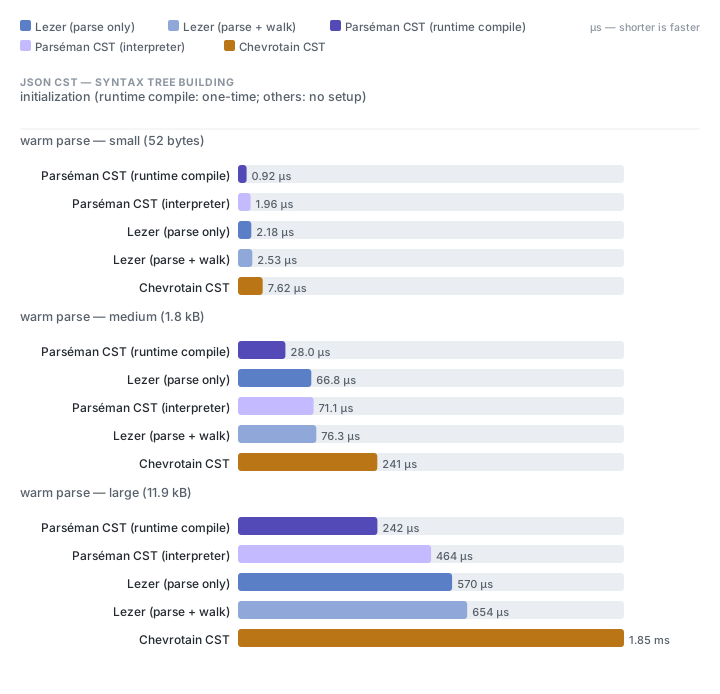
| Parser | small (52 B) | medium (1.8 kB) | large (11.9 kB) | Output |
|---|---|---|---|---|
| Parséman CST (runtime compile) | 0.58 µs | 18.03 µs | 151.87 µs | object tree + spans |
| Lezer (parse only) | 2.34 µs | 70.29 µs | 582.14 µs | compact buffer tree |
| Lezer (parse + walk) | 2.68 µs | 78.38 µs | 660.45 µs | compact buffer tree |
| Parséman CST (interpreter) | 1.87 µs | 64.14 µs | 459.82 µs | object tree + spans |
| Chevrotain CST | 7.38 µs | 235.09 µs | 1.82 ms | object CST |
Compiled Parséman is ahead of Lezer at every size here — about 3.9× at the large fixture — while producing an object tree you can use directly, with a span on every node. Turning on captureTrivia to log whitespace for a formatter costs about 5% on this fixture, which is why it doesn't get its own bar.
That comparison deserves an asterisk, though, and it's a real one: Lezer emits a compact buffer tree tuned for CodeMirror's incremental pipeline, and Parséman emits JS objects a formatter or refactor can walk without a second pass. Different outputs for different consumers. Pick the one yours actually needs.
Even the setup-free interpreter holds its own against a purpose-built incremental generator — faster than Lezer parse-only at every measured size (1.87 vs 2.34 µs, 64.14 vs 70.29 µs, 460 vs 582 µs) while building the richer tree, and roughly 3.7–4.0× faster than Chevrotain throughout.
Incremental re-parse
Editors re-parse on every keystroke, so re-parsing only what changed is the whole game. Parséman (parseDoc) and Lezer both do it, but their cost curves are shaped differently — different enough that the winner flips depending on what kind of edit you made. Measured on a 12 kB nested JSON fixture, with every row verified span-correct against a full reparse:
| Edit | Parséman incremental | Lezer incremental | Full reparse |
|---|---|---|---|
| Overtype a value (same length) | 4.6 µs | 107 µs | ~510 µs |
| Insert a character (+1) | 8.1 µs | 108 µs | ~510 µs |
| Insert a new element (structural) | 29 µs | 8.0 µs | ~510 µs |
The trick is that Parséman stores parent-relative spans. A length-changing edit never has to rewrite the offsets of everything after it: a subtree that slides along with its parent keeps its own offsets untouched and gets shared by identity. That makes all three edit kinds cheap, in different amounts:
- In-place value edits — overtyping, or adding a character to a token you're in the middle of. This is what typing actually is, most of the time. Only the smallest containing rule re-parses; everything else is shared by reference. An overtype comes out ~110× faster than a full reparse and ~20× ahead of Lezer, and a character insert is nearly as cheap, since there's no O(n) offset shift waiting at the end.
- Structural edits — inserting or removing an element in a large collection — reuse the collection's untouched tail elements by identity (opt-in
structuralReuse), re-parsing only the disturbed span. That takes the 200-element-array insert from ~full-reparse cost down to ~30 µs — within a few × of Lezer's chunked buffer-tree reuse, which does the tail shift in O(log) where Parséman's flat object list does it in O(trailing siblings).
When you need absolute positions, spanAt(path) walks them in O(depth), or absolutizeCST(tree) does the whole tree at once. If your editor mostly sees value edits — a linter or formatter re-running as tokens change — re-parsing is effectively free. Even heavy structural churn stays within a small factor of Lezer.
The short version
For parsing to JS values — objects, rows, AST nodes — the compiled artifact is the fastest general-purpose JS parser in this comparison, at every grammar and every size measured. For syntax trees, it's ahead of Lezer and Chevrotain on the JSON fixture. The setup-free interpreter leads every external parser on JSON, CSV, and GraphQL.
All of it comes from a suite you can run yourself (pnpm bench:svg), on one M4 Pro and Node 24.11.1, three rotated rounds with one parser per process. Think a parser belongs in here and isn't? Open an issue — the harness in bench/run.ts was built to take new entrants.
Refreshing the charts
To update the comparison SVGs in assets/ (used by this page):
pnpm bench:svg # run chart-only benchmarks, then write assets/bench-*.svgThat's the whole workflow. It runs only the JSON / CSV / GraphQL / CST-JSON timings the charts need, not the full pnpm bench suite — but the small fixtures run a lot of iterations, so give it several minutes.
| Command | What it does |
|---|---|
pnpm bench:svg | Update charts — benchmark chart parsers + write assets/bench-*.svg |
pnpm bench | Parser-to-parser comparison |
pnpm bench:parseman | Parseman interpreted vs compiled regression report |
pnpm bench:baseline | Refresh Parseman regression baseline + history snapshot |
pnpm perf:guard | Fast pre-commit CSS speed regression check |
The init-cost bars are pinned in bench/chart-types.ts rather than measured each run — they swing wildly by machine and would only add noise. Warm-parse bars are always live.
For regression guarding, see Performance → Measuring.